In Situ Urchin Behavior Study
Self-Built Underwater Camera System for Continuous Monitoring
Overview
This project began with a pressing ecological question: how fast are purple urchins repopulating once removed, and how does their behavior vary by light, food, and time of day? Commercial monitoring systems like MBARI's SeeStar cost $2,500+ and were designed for deep-sea use, not small-scale coastal research. So I built my own.
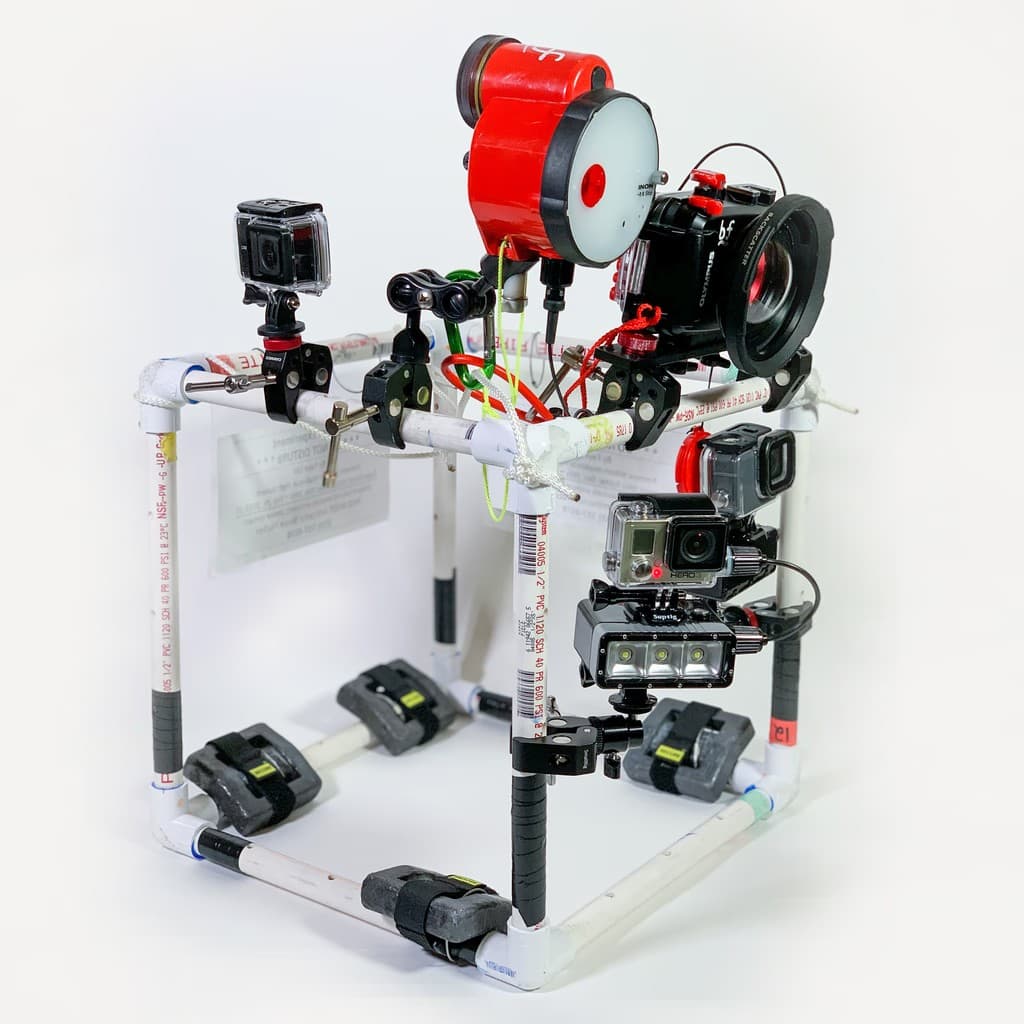
Over three design phases, I developed a modular rig of PVC piping and cameras with custom housings and extended battery packs, achieving long-duration recording at 30–54 ft depth under real ocean conditions.
The problem
Kelp forests were collapsing after sea star wasting disease and marine heatwaves fueled a purple urchin population explosion. No affordable, continuous, in situ system existed to measure urchin movement or repopulation at shallow coastal depths.
Approach
- Phase I: Simple PVC frame + Olympus TG-4 with strobe, achieving 16-hour overnight timelapse but limited by shot count.
- Phase II: Custom 6" PVC housing with polycarbonate discs and external battery packs. Solved battery life but too bulky to deploy easily.
- Phase III: Streamlined rig with GoPro Hero 7s and hybrid Olympus setup; compact anchoring; recorded at 0.5s intervals day, 2-minute intervals night.
Outcomes
- Achieved 16–48 hours of continuous recording at 30–54 ft depths.
- Quantified that urchins move only inches every 10 minutes, primarily repopulating from rocky crevices.
- Confirmed nocturnal movement patterns and light avoidance behavior.
- Observed that movement does not equal eating: urchins moved at night but did not always consume kelp proportionally.
Recognition
ACSEF First Place · NASA + NOAA Special Awards · Broadcom MASTERS Top 300
Stack & tools
Olympus TG-4 + Inon D-2000 strobe, GoPro Hero 3/7, DBPower 4K action camera, custom PVC frame.