WAL-SEA
A Homebuilt, Multifunctional ROV for Near-Shore Ecosystems
Overview
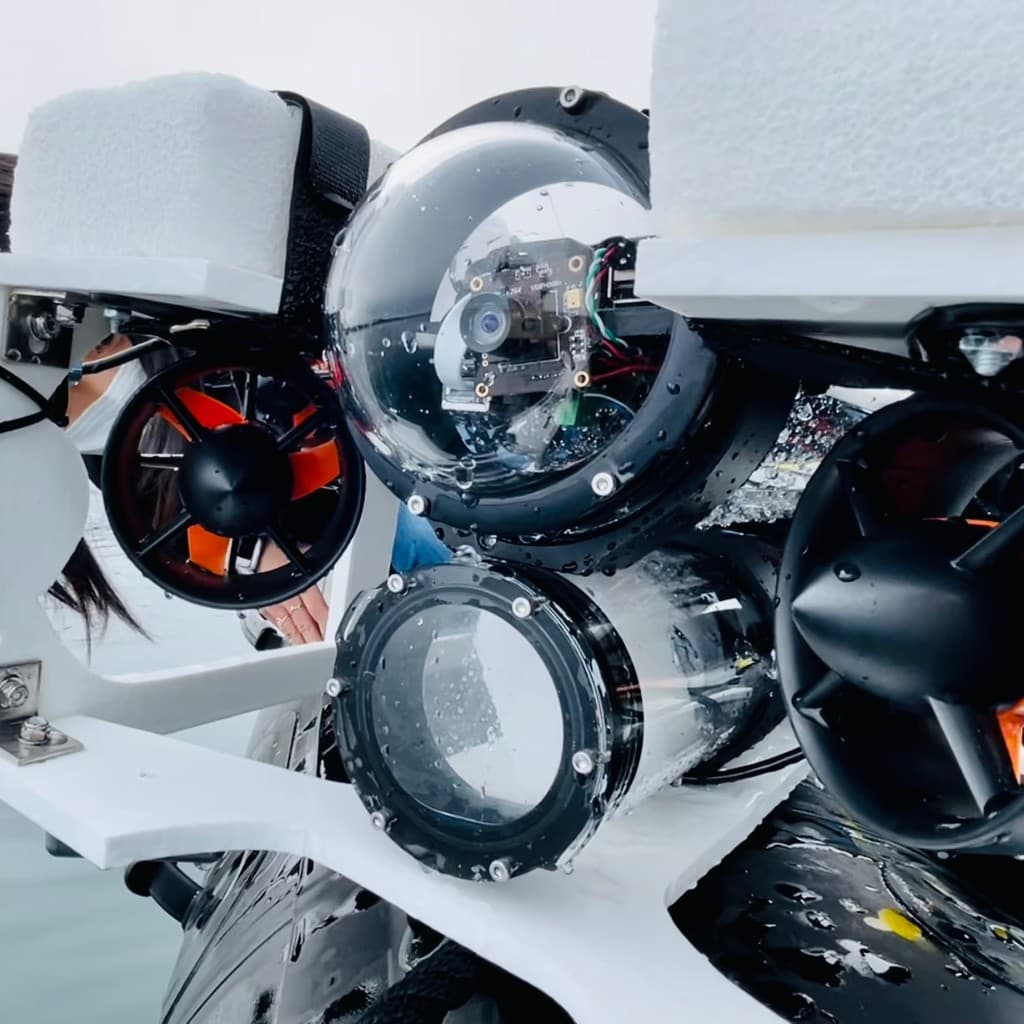
WAL-SEA is a homebuilt, multifunctional remotely operated vehicle designed to combat kelp forest collapse caused by unchecked purple sea urchin populations. Existing diver-led culling is costly, slow, and unscalable, so I set out to build a modular ROV that could both survey and actively remove urchins with far greater efficiency.
Over two years I designed, built, and field-tested WAL-SEA through four major development phases: initial beta prototypes, a main ROV platform, mission-specific modules, and full assembly and deployment.
The problem
88.3% of kelp forests in Monterey Bay are collapsing due to overpopulated purple sea urchins, a cascading crisis triggered by sea star wasting disease and marine heatwaves. Diver-only culling is too slow, too costly, and too limited to scale.
Approach
- Designed four prototype phases: beta → main platform → mission modules → full assembly.
- Solved water intrusion with compression-fit cable penetrators; optimized buoyancy using high-density foam and ballast weights.
- Built two modular attachments: a survey module (4K/30fps, dimmable subsea lighting) and a vacuum module (stainless scraper, tilting thruster, collection net).
- Conducted 7 ocean deployments at Del Monte Beach across varying surge, depth, and visibility conditions.
Outcomes
- 10x survey speed and 6x efficiency: 1 acre in ~20 minutes vs. 75 minutes for divers.
- Reliable 40–60 ft operating envelope with hour-long missions and 4K footage.
- Vacuum module successfully scraped and collected multiple urchins per pass.
- Generated urchin density maps from overlapping survey transects for targeted restoration.
Recognition
ACSEF Grand Award winner · ISEF Finalist · Regeneron STS Top 300 Scholar · Published in IEEE Xplore
Stack & tools
SolidWorks, Arduino, Pixhawk, Raspberry Pi, Handbuilt ROV.